Corporate contract production (CDMO)
Year-round contract production of functional, high-value crops — roses, Harucho, purslane, chrysanthemum, centella, wasabi, aralia, medical cannabis.
 KO · EN
AgDome · Build
AgDome is not a greenhouse. Inside a positive-pressure, double-membrane sealed structure that stands on its own, it shuts out external climate and contamination and turns 1,000-pyeong (3,300 m²) production into a repeatable process.
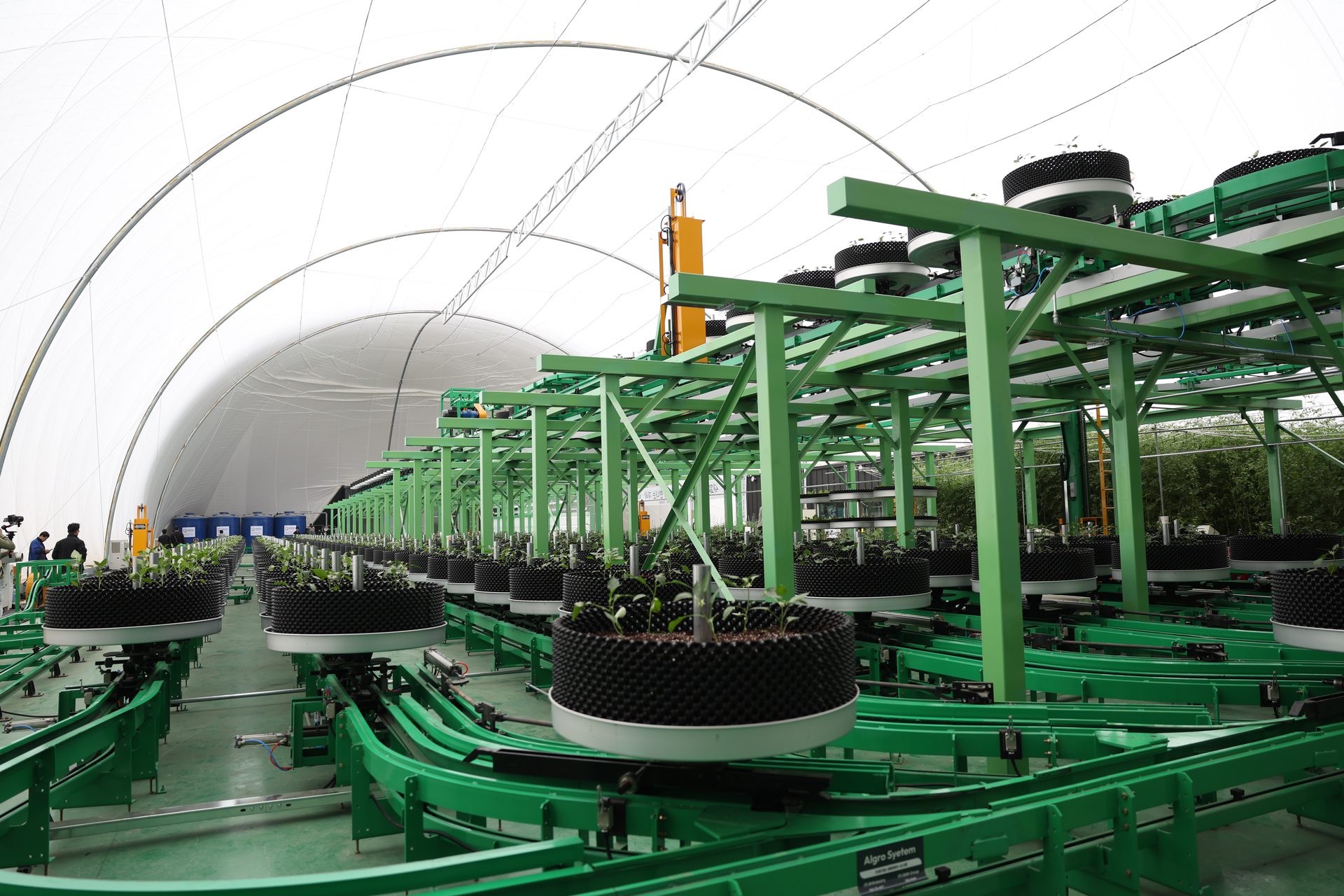
Standard unit
AgDome is not a larger greenhouse. One standard unit is a column-free span of 3,300 m² (1,000 pyeong) — 100 m long, 32 m wide and 17 m high, the height of a five-storey building. Because the next unit is produced from the same drawings, the same bill of materials and the same operating procedures, agriculture can be designed, built and run the way manufacturing is.
| Floor area | 3,300 m² (1,000 pyeong) · 1 unit |
| Length × width × height | 100 m × 32 m × 17 m |
| Structure | Self-supporting positive-pressure double membrane · column-free · machinery access |
| Internal pressure | +0.8 – 2.5 % above ambient, automatically controlled |
| Air | Triple filtration · sterilised recirculation · PM2.5 excluded |
| Vertical stacking | 5 – 15× open-field output per unit area with multi-tier cultivation |
| Expansion | Extendable beyond 6,600 m² without columns · added unit by unit |
| Construction | 3 months · modular · documented standard process |
Engineering
CFD-designed positive-pressure air handling. Blocks particulates, pests and external contamination and circulates clean air. Double membrane: zero condensation and pest incidence. Pharma/bio-grade reproducibility.
A streamlined arch that stands by positive pressure. No columns: machinery can enter, wind load is distributed. Modular construction in three months, deployed as a repeated standard unit.
Multi-source hybrid thermal system. Air-source and ground/water-source heat combined through a proprietary Pipe-in-Pipe secondary loop and Active Thermal Buffer (ATB): 70% lower energy cost in both extreme heat and cold. Combined with agrivoltaics, RE100-ready.
Proprietary diffused-light film removes shadow zones for uniform growth across the unit; U-value 1.2–1.5 W/m²K, 60% better insulation than conventional structures.
Hybrid infrastructure
AgDome does not depend on a single heat source. Air, ground and water heat are combined as conditions require, and agrivoltaic power meets RE100 requirements. Because energy, structure and operation are standardized inside one unit, it becomes infrastructure that can be manufactured, documented and standardized — a product that repeats, not a facility.
Operating proof
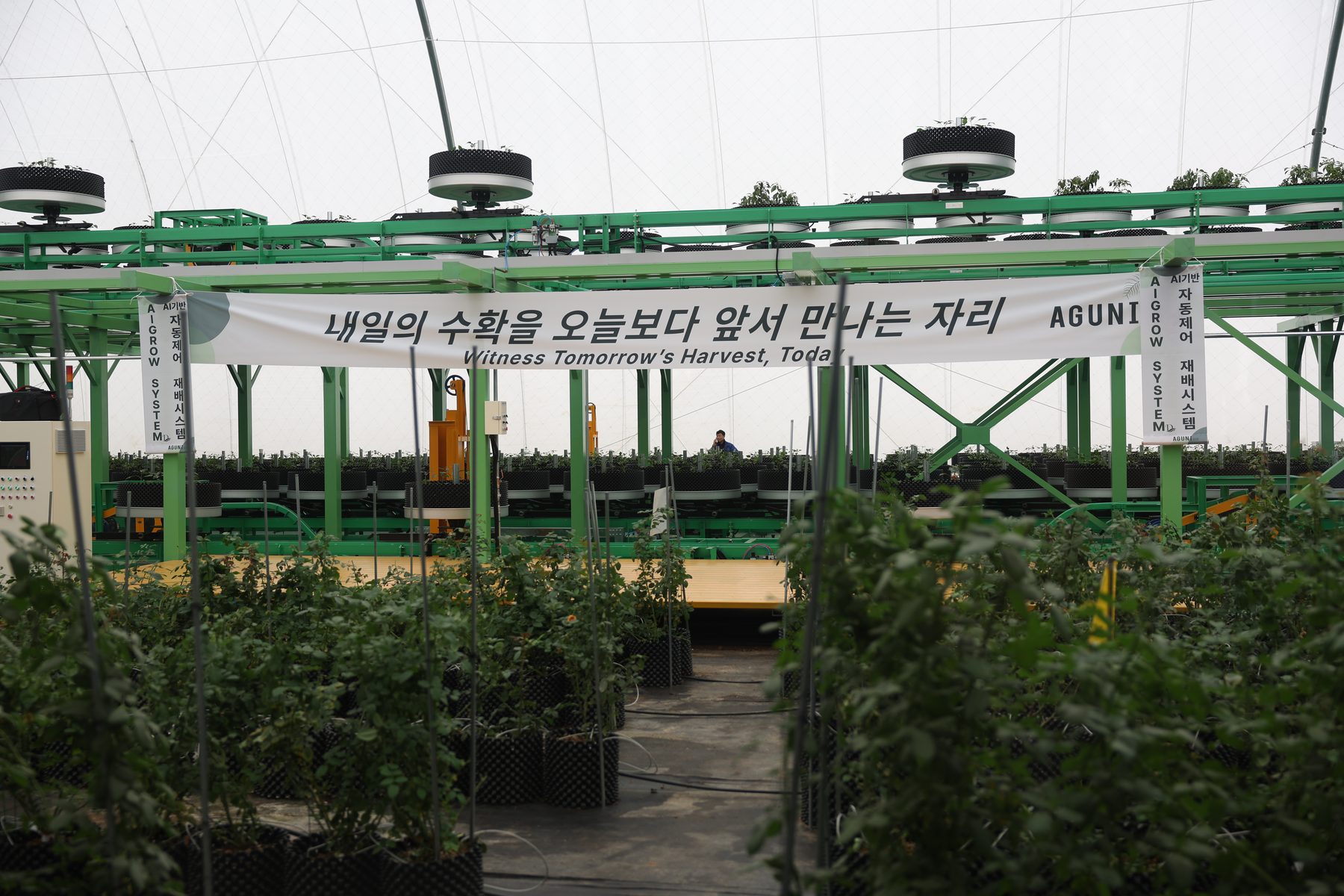
A 16,500 m² site in Hwaseong, Gyeonggi-do: two AgDomes, a plant factory and a nursery in one place.
±0.5°C environmental control, 70% lower energy cost, reproducible growth — through real production we accumulate CAPEX/OPEX, environmental control, quality, energy and maintenance data. This record is the first benchmark we present to the next region and the next financier.
Comparison
| Plastic greenhouse | Glass greenhouse | Plant factory | AgDome | |
|---|---|---|---|---|
| Construction cost | KRW 0.1–0.2bn | 0.8–1.5bn | 3–5bn | 3bn |
| Construction time | 2–4 weeks | 6–12 months | 12–18 months | 3 months |
| Labor | 5–8 | 3–5 | 8–15 | 1–2 (AgOS) |
| Annual energy cost | 30–50m | 80–120m | 200–400m | 12m |
| Year-round | △ | ○ | ○ | ○ 365 days |
| Pests | High | Medium | Low | 0% (positive pressure) |
| Carbon credits | — | — | Limited | ○ D-MRV |
Use cases
Year-round contract production of functional, high-value crops — roses, Harucho, purslane, chrysanthemum, centella, wasabi, aralia, medical cannabis.
Local food infrastructure that keeps producing through summer heat waves, floods and shifting terrain, and through −40°C winters. Summer variant designed in Europe; winter variant for Mongolia's western aimags.
Mass production of seedlings for land restoration and afforestation regardless of season — connected to national restoration pipelines.
Public pilot units owned by education offices or municipalities and operated by AgUni — hubs for local growers moving to high-value crops.